
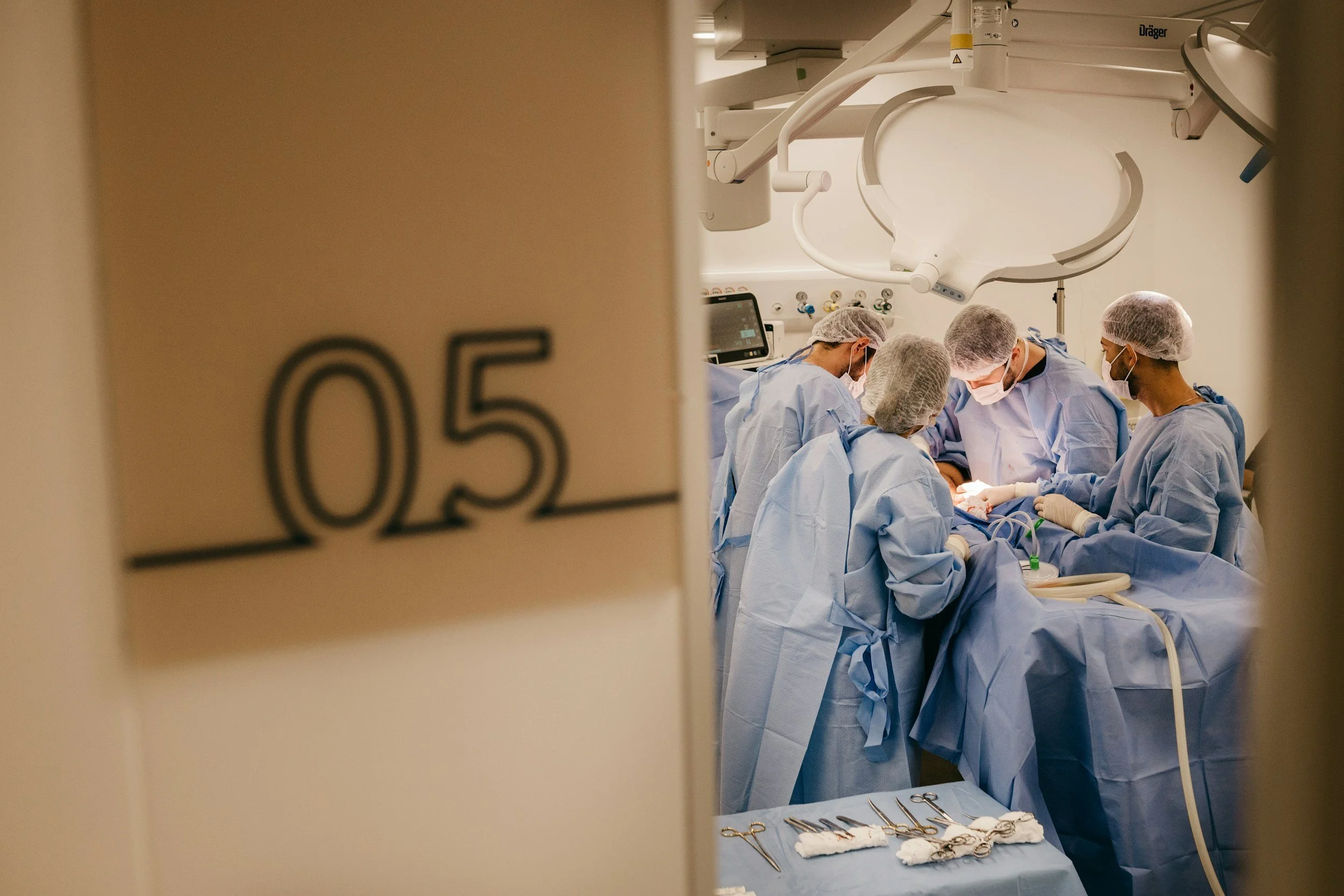
A hidden danger in nearly every hospital — and almost no one is counting it.
International data predicts 300 to 400 perioperative chlorhexidine anaphylaxis cases in the United States each year. The U.S. Food and Drug Administration's adverse event database has recorded 52 cases in 46 years. The Hoffmann Goldsword Foundation exists to make that gap visible.
What Happened
On October 16, 2024, Katherine Goldsword went into perioperative cardiac arrest from an undiagnosed allergy to chlorhexidine. She was discharged three days later without a diagnosis. The Foundation's work begins there.
The Hidden Risk
Chlorhexidine is in nearly every U.S. surgical prep, ICU bath, dental cleaning, and wound dressing — and most patients will never see it on a label. Three reasons that matters.
The Investigation
The Foundation's investigative brief documents what international data predicts should be happening in U.S. operating rooms each year — and what U.S. data records instead. About 3,000 words.
Research & Evidence
A library of Foundation working papers organized across five pillars. Hundreds of analyses on documentation failure, exposure pathways, recognition gaps, and reform — browsable by pillar, arc, and mechanism.
Our Mission
Awareness, documentation, protocol. The Foundation's mission is to turn a known hazard into a recognizable one. Five values define how we work.
Get Involved
The Foundation runs on contributions from people who recognize the gap and want to help close it. Donate, share, partner, or reach out.
"This allergy should be considered severe and life-threatening."
— Barry J. Pelz, MD, Medical College of Wisconsin / Children's Wisconsin · July 3, 2025 clinical letter
The crisis, in brief
Chlorhexidine is the antiseptic almost everyone meets — and almost no one tracks.
It’s scrubbed over surgical sites, soaked into the wipes sent home the night before, swabbed into mouths, coated onto catheters and lines. For almost everyone, it quietly does its job. For a growing number, the body turns on it — and the system was never built to see it coming. Here is the short version of what we found. Hover or tap a card to read more.
A danger you acquire, not one you’re born with
Chlorhexidine hypersensitivity is, in most cases, acquired. The immune system isn’t born primed against it — it learns, through repeated ordinary exposure, and the process can run silently for years with no rash and no warning. By the time there is a “first symptom,” it can be anaphylaxis.
That changes who is at risk. If the danger were inborn, it would belong to a small, identifiable group. Because it’s acquired through exposure, the at-risk group is defined by exposure instead — and exposure to chlorhexidine is nearly universal in modern care. The population quietly accumulating it isn’t a niche. It’s functionally everyone who passes through a hospital.
A free amplifier, hiding in plain sight
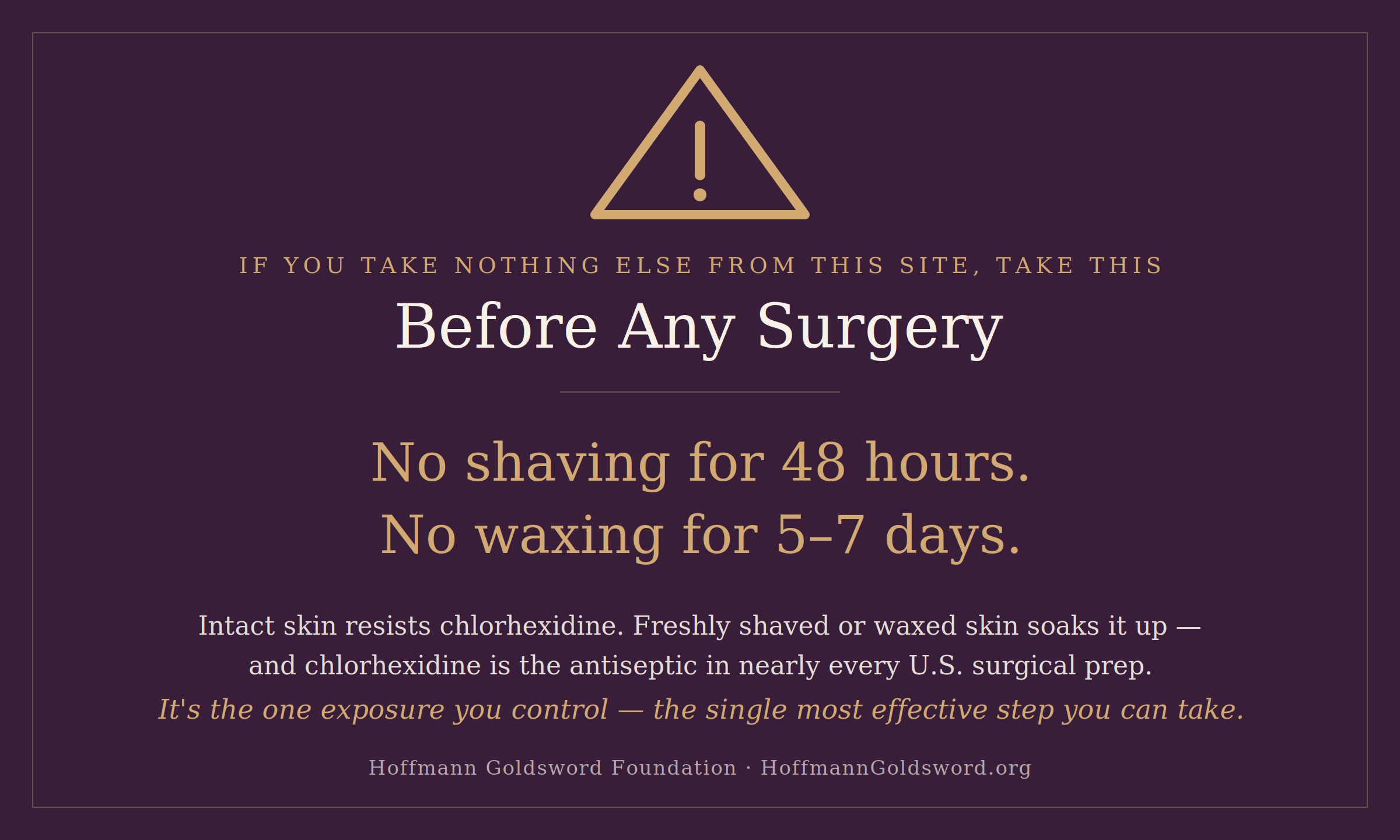
Chlorhexidine is absorbed through the skin, and intact skin is a fairly good barrier. Freshly shaved or waxed skin is not — its surface is stripped, and it absorbs more of whatever is applied to it. That is the load-bearing point from the peer-presented case at the center of our investigation.
It doesn’t mean a shave causes the allergy, or that intact skin is safe. It means the dose is one of the few variables a patient actually controls — and right now nothing in the system tells you so. A small, free, avoidable amplifier, sitting in plain sight.
Recognized in the literature, invisible at the bedside
Recognition and protection are not the same thing, and the distance between them is where patients get hurt. A risk can be well established in the literature and operationally invisible at the bedside at the same time. In the United Kingdom’s national audit, chlorhexidine was suspected in only about a quarter of the cases it actually caused.
And the blindness compounds. A reaction that isn’t recognized is never confirmed; one that’s confirmed still can’t be counted, because chlorhexidine allergy has no diagnostic code of its own; and nothing actively watches for it. Other countries went looking decades ago. The United States issued a label change and left the counting to whatever happened to be reported.
The number that looks reassuring is the problem
In 2017 the FDA tallied 52 reports of anaphylaxis to skin-applied chlorhexidine across 46 years. Set against the tens of millions exposed annually, that reads as reassurance. But when the U.K. went actively looking, chlorhexidine caused about 9% of life-threatening surgical anaphylaxis — a rate that, applied to the 40 to 50 million U.S. surgeries each year, predicts 300 to 400 cases annually.
Not over forty-six years. Every year. Cut the estimate by more than half and the two numbers still don’t live in the same world. The rarity isn’t a property of the danger. It’s a property of the measurement — the silence of a system that wasn’t looking.
We’ve seen this before. It was called latex.
A generation ago, as universal precautions took hold, latex exposure became near-universal across medicine — and an epidemic of acquired sensitivity followed, until latex stood among the leading causes of allergic reactions in the operating room. The response didn’t cure anyone; it removed the exposure, with powder-free gloves, latex-safe rooms, and a federal labeling rule. It worked.
Chlorhexidine fits that shape almost exactly — one stage earlier. It’s ubiquitous, still expanding, acquired through cumulative exposure, and already a leading surgical allergen. The difference is that latex was made visible. Chlorhexidine, by and large, still isn’t.
What you can do right now
Before any procedure, don’t shave or wax the area first — disrupted skin absorbs more, and it’s one of the few things you control. It isn’t protection from a reaction, but it costs nothing, and nothing in the system tells you to do it.
If you’ve ever reacted to an antiseptic wipe, a surgical scrub, a chlorhexidine mouthwash, or a coated catheter, say so before your next procedure — and ask whether a chlorhexidine-free preparation can be used. You don’t need a confirmed diagnosis to ask. And tell the people you love: the next person it protects may be someone who would otherwise never have heard it.
This is the short version. The full investigation lays out the case, the evidence, and the numbers in depth.
Read the full investigation →By Kenneth Hoffmann and Katherine Hoffmann Goldsword, Founders · Hoffmann Goldsword Foundation
© 2025–2026 Hoffmann Goldsword LLC ·
Licensed to the Hoffmann Goldsword Foundation ·
Published under CC BY-NC-SA 4.0
https://creativecommons.org/licenses/by-nc-sa/4.0/
·
HoffmannGoldsword.org
Commercial use or syndication requires a separate license from
Hoffmann Goldsword LLC
MediaGroup@HoffmannGoldsword.com
The Foundation’s Approach
Accuracy Over Urgency
Careful documentation over rushed conclusions.
Prevention Over Reaction
Helping patients reduce risk before harm occurs.
Visibility Over Silence
Making overlooked reactions impossible to ignore.
Design Over Blame
Improving systems, protocols, and recognition pathways.
Open Knowledge
Research and evidence made accessible to everyone.

Support the Foundation
The Hoffmann Goldsword Foundation exists to close the gap between what is happening and what is being recognized. Your support helps advance awareness, research, documentation, and prevention efforts surrounding chlorhexidine-related reactions.